Problem Statement
Amidakuji is a traditional method of lottery in Japan.
To make an amidakuji, we first draw $W$ parallel vertical lines, and then draw horizontal lines that connect them. The length of each vertical line is $H+1$ [cm], and the endpoints of the horizontal lines must be at $1, 2, 3, ...,$ or $H$ [cm] from the top of a vertical line.
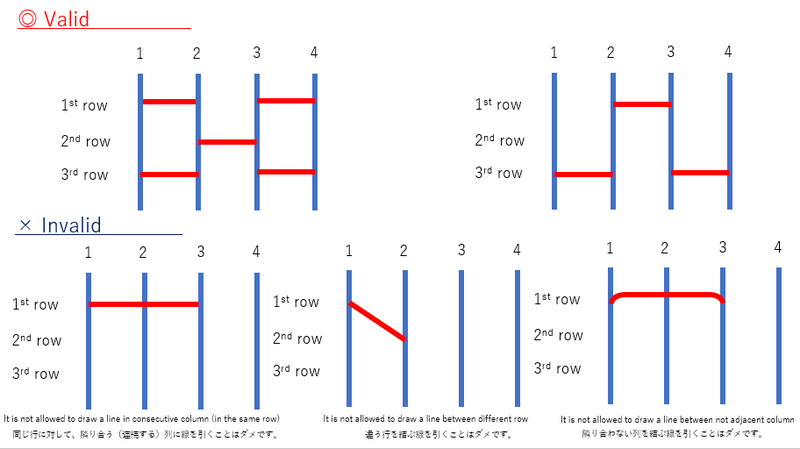
A valid amidakuji is an amidakuji that satisfies the following conditions:
- No two horizontal lines share an endpoint.
- The two endpoints of each horizontal lines must be at the same height.
- A horizontal line must connect adjacent vertical lines.
Find the number of the valid amidakuji that satisfy the following condition, modulo $1\ 000\ 000\ 007$: if we trace the path from the top of the leftmost vertical line to the bottom, always following horizontal lines when we encounter them, we reach the bottom of the $K$-th vertical line from the left.
For example, in the following amidakuji, we will reach the bottom of the fourth vertical line from the left.

Constraints
$H$is an integer between$1$and$100$(inclusive).$W$is an integer between$1$and$8$(inclusive).$K$is an integer between$1$and$W$(inclusive).
Input
Input is given from Standard Input in the following format:
H W KOutput
Print the number of the amidakuji that satisfy the condition, modulo $1\ 000\ 000\ 007$.
样例
1 3 2
1
1 3 1
2
2 3 3
1
2 3 1
5
7 1 1
1
15 8 5
437760187
题面与样例版权归 AtCoder 及出题人所有;中文翻译由 AI 生成(CI 管线),如有出入请以原文为准。