Problem Statement
There is a railroad in Takahashi Kingdom. The railroad consists of $N$ sections, numbered $1$, $2$, ..., $N$, and $N+1$ stations, numbered $0$, $1$, ..., $N$. Section $i$ directly connects the stations $i-1$ and $i$. A train takes exactly $A_i$ minutes to run through section $i$, regardless of direction. Each of the $N$ sections is either single-tracked over the whole length, or double-tracked over the whole length. If $B_i = 1$, section $i$ is single-tracked; if $B_i = 2$, section $i$ is double-tracked. Two trains running in opposite directions can cross each other on a double-tracked section, but not on a single-tracked section. Trains can also cross each other at a station.
Snuke is creating the timetable for this railroad. In this timetable, the trains on the railroad run every $K$ minutes, as shown in the following figure. Here, bold lines represent the positions of trains running on the railroad. (See Sample 1 for clarification.)
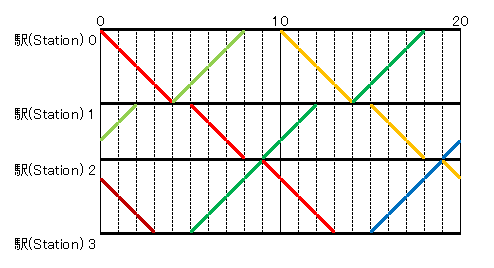
When creating such a timetable, find the minimum sum of the amount of time required for a train to depart station $0$ and reach station $N$, and the amount of time required for a train to depart station $N$ and reach station $0$. It can be proved that, if there exists a timetable satisfying the conditions in this problem, this minimum sum is always an integer.
Formally, the times at which trains arrive and depart must satisfy the following:
- Each train either departs station
$0$and is bound for station$N$, or departs station$N$and is bound for station$0$. - Each train takes exactly
$A_i$minutes to run through section$i$. For example, if a train bound for station$N$departs station$i-1$at time$t$, the train arrives at station$i$exactly at time$t+A_i$. - Assume that a train bound for station
$N$arrives at a station at time$s$, and departs the station at time$t$. Then, the next train bound for station$N$arrives at the station at time$s+K$, and departs the station at time$t+K$. Additionally, the previous train bound for station$N$arrives at the station at time$s-K$, and departs the station at time$t-K$. This must also be true for trains bound for station$0$. - Trains running in opposite directions must not be running on the same single-tracked section (except the stations at both ends) at the same time.
Constraints
$1 \leq N \leq 100000$$1 \leq K \leq 10^9$$1 \leq A_i \leq 10^9$$A_i$is an integer.$B_i$is either$1$or$2$.
Partial Score
- In the test set worth
$500$points, all the sections are single-tracked. That is,$B_i = 1$. - In the test set worth another
$500$points,$N \leq 200$.
Input
The input is given from Standard Input in the following format:
N K
A_1 B_1
A_2 B_2
:
A_N B_NOutput
Print an integer representing the minimum sum of the amount of time required for a train to depart station $0$ and reach station $N$, and the amount of time required for a train to depart station $N$ and reach station $0$. If it is impossible to create a timetable satisfying the conditions, print $-1$ instead.
样例
3 10
4 1
3 1
4 1
26
1 10
10 1
-1
6 4
1 1
1 1
1 1
1 1
1 1
1 1
12
20 987654321
129662684 2
162021979 1
458437539 1
319670097 2
202863355 1
112218745 1
348732033 1
323036578 1
382398703 1
55854389 1
283445191 1
151300613 1
693338042 2
191178308 2
386707193 1
204580036 1
335134457 1
122253639 1
824646518 2
902554792 2
14829091348
题面与样例版权归 AtCoder 及出题人所有;中文翻译由 AI 生成(CI 管线),如有出入请以原文为准。