Problem Statement
There is a grid of $H$ rows and $W$ columns. The rows are numbered $0,1,\ldots,H-1$ from top to bottom, and the columns are numbered $0,1,\ldots,W-1$ from left to right. Let $(i,j)$ denote the cell at row $i$ and column $j$.
You are given $H$ strings $S_0, S_1, \ldots, S_{H-1}$, each of which is of length $W$ and consists of A and B.
In each cell, one of the following two types of tiles is placed. Let $S_{ij}$ denote the $(j+1)$-th character $(0 \le j \le W-1)$ of the string $S_i$. The type of tile placed in cell $(i,j)$ is $S_{ij}$.
- Type A: A single line segment is drawn on the tile’s surface, connecting the midpoints of two adjacent edges.

- Type B: A single line segment is drawn on the tile’s surface, connecting the midpoints of two opposite edges.

These tiles can be freely rotated. When focusing only on the pattern formed by the line segments, there are four ways to rotate a Type-A tile and two ways to rotate a Type-B tile. Therefore, if we distinguish placements only by the pattern of line segments, the number of ways to place the tiles is $4^a \times 2^b$, where $a$ is the number of Type-A tiles and $b$ is the number of Type-B tiles.
Among these ways, print the number, modulo $998244353$, of ways such that the line segments on the tiles have no dead ends when viewing the grid as a torus.
Here, "the line segments on the tiles have no dead ends when viewing the grid as a torus" if and only if the following two conditions are satisfied for every cell $(i,j)$:
- Both of the following exist, or neither of the following exists:
- the line segment drawn in the cell
$(i,j)$, whose endpoint is the midpoint of the right edge of the cell$(i,j)$- the line segment drawn in the cell
$(i,(j+1)\bmod W)$, whose endpoint is the midpoint of the left edge of the cell$(i,(j+1)\bmod W)$
- the line segment drawn in the cell
- Both of the following exist, or neither of the following exists:
- the line segment drawn in the cell
$(i,j)$, whose endpoint is the midpoint of the bottom edge of the cell$(i,j)$- the line segment drawn in the cell
$((i+1)\bmod H,j)$, whose endpoint is the midpoint of the top edge of the cell$((i+1)\bmod H,j)$
- the line segment drawn in the cell
For example, the following placement satisfies the condition:
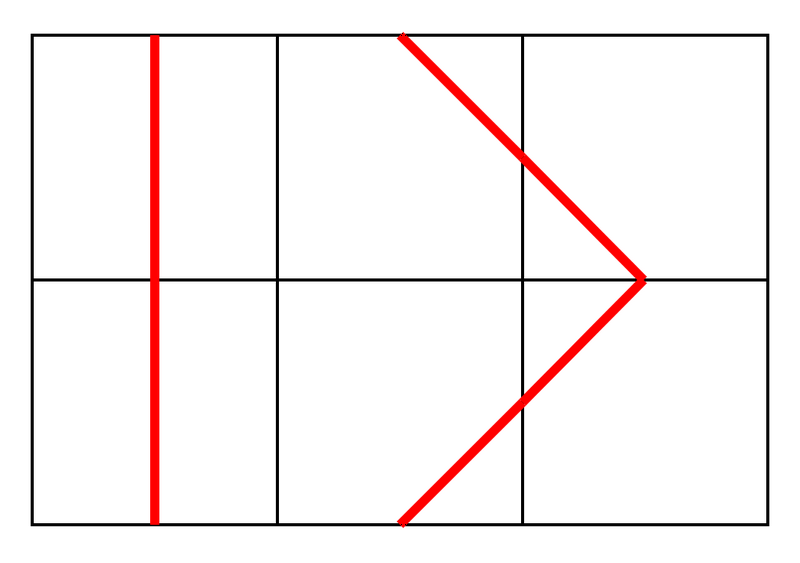
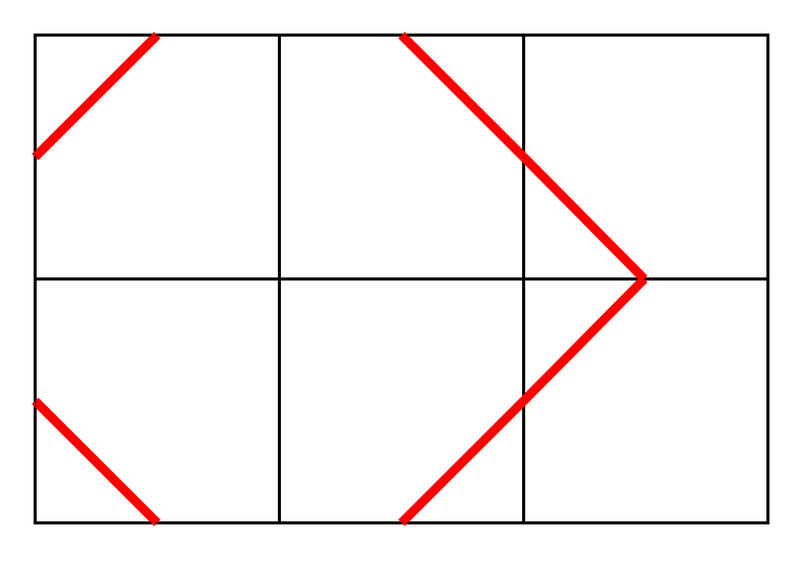
The following placement does not satisfy the condition. Specifically, while there is no line segment whose endpoint is the midpoint of the right edge of the tile in cell $(0,2)$, there is a line segment whose endpoint is the midpoint of the left edge of the tile in cell $(0,0)$, so the condition is not satisfied.
You are given $T$ test cases; solve each of them.
Constraints
$1 \le T \le 10^5$$2 \le H,W$$HW\leq 10^6$$S_i\,(0\le i\le H-1)$are length-$W$strings consisting ofAandB.- The sum of
$H W$over all test cases is at most$10^6$. $T$,$H$, and$W$are integers.
Input
The input is given from Standard Input in the following format:
T
case_1
case_2
\vdots
case_TEach case is given in the following format:
H W
S_0
S_1
\vdots
S_{H-1}Output
For each test case, print the number, modulo $998244353$, of placements that satisfies the condition, in separate lines.
样例
3
3 3
AAB
AAB
BBB
3 3
BBA
ABA
AAB
3 4
BAAB
BABA
BBAA
2
0
2
题面与样例版权归 AtCoder 及出题人所有;中文翻译由 AI 生成(CI 管线),如有出入请以原文为准。