Let's call an undirected graph of $*n*$ vertices $*p*$-interesting, if the following conditions fulfill:
- the graph contains exactly
$2*n* + *p*$edges; - the graph doesn't contain self-loops and multiple edges;
- for any integer
$*k*$($1 ≤ *k* ≤ *n*$), any subgraph consisting of$*k*$vertices contains at most$2*k* + *p*$edges.
A subgraph of a graph is some set of the graph vertices and some set of the graph edges. At that, the set of edges must meet the condition: both ends of each edge from the set must belong to the chosen set of vertices.
Your task is to find a $*p*$-interesting graph consisting of $*n*$ vertices.
Input
The first line contains a single integer $*t*$ ($1 ≤ *t* ≤ 5$) — the number of tests in the input. Next $*t*$ lines each contains two space-separated integers: $*n*$, $*p*$ ($5 ≤ *n* ≤ 24$; $*p* ≥ 0$; 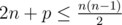 ) — the number of vertices in the graph and the interest value for the appropriate test.
It is guaranteed that the required graph exists.
Output
For each of the $*t*$ tests print $2*n* + *p*$ lines containing the description of the edges of a $*p*$-interesting graph: the $*i*$-th line must contain two space-separated integers $*a*_{*i*}, *b*_{*i*}$ ($1 ≤ *a*_{*i*}, *b*_{*i*} ≤ *n*; *a*_{*i*} ≠ *b*_{*i*}$) — two vertices, connected by an edge in the resulting graph. Consider the graph vertices numbered with integers from $1$ to $*n*$.
Print the answers to the tests in the order the tests occur in the input. If there are multiple solutions, you can print any of them.
样例
1
6 0
1 2
1 3
1 4
1 5
1 6
2 3
2 4
2 5
2 6
3 4
3 5
3 6
题面与样例版权归 Codeforces 及出题人所有;中文翻译由 AI 生成(CI 管线),如有出入请以原文为准。