There's a famous museum in the city where Kleofáš lives. In the museum, $*n*$ exhibits (numbered $1$ through $*n*$) had been displayed for a long time; the $*i*$-th of those exhibits has value $*v*_{*i*}$ and mass $*w*_{*i*}$.
Then, the museum was bought by a large financial group and started to vary the exhibits. At about the same time, Kleofáš... gained interest in the museum, so to say.
You should process $*q*$ events of three types:
- type
$1$— the museum displays an exhibit with value$*v*$and mass$*w*$; the exhibit displayed in the$*i*$-th event of this type is numbered$*n* + *i*$(see sample explanation for more details) - type
$2$— the museum removes the exhibit with number$*x*$and stores it safely in its vault - type
$3$— Kleofáš visits the museum and wonders (for no important reason at all, of course): if there was a robbery and exhibits with total mass at most$*m*$were stolen, what would their maximum possible total value be?
For each event of type 3, let $*s*(*m*)$ be the maximum possible total value of stolen exhibits with total mass $≤ *m*$.
Formally, let $*D*$ be the set of numbers of all exhibits that are currently displayed (so initially $*D*$ = {1, ..., n}). Let $*P*(*D*)$ be the set of all subsets of $*D*$ and let

Then, $*s*(*m*)$ is defined as
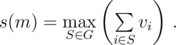
Compute $*s*(*m*)$ for each  . Note that the output follows a special format.
Input
The first line of the input contains two space-separated integers $*n*$ and $*k*$ ($1 ≤ *n* ≤ 5000$, $1 ≤ *k* ≤ 1000$) — the initial number of exhibits in the museum and the maximum interesting mass of stolen exhibits.
Then, $*n*$ lines follow. The $*i*$-th of them contains two space-separated positive integers $*v*_{*i*}$ and $*w*_{*i*}$ ($1 ≤ *v*_{*i*} ≤ 1 000 000$, $1 ≤ *w*_{*i*} ≤ 1000$) — the value and mass of the $*i*$-th exhibit.
The next line contains a single integer $*q*$ ($1 ≤ *q* ≤ 30 000$) — the number of events.
Each of the next $*q*$ lines contains the description of one event in the following format:
$1 *v* *w*$— an event of type 1, a new exhibit with value$*v*$and mass$*w*$has been added ($1 ≤ *v* ≤ 1 000 000$,$1 ≤ *w* ≤ 1000$)$2 *x*$— an event of type 2, the exhibit with number$*x*$has been removed; it's guaranteed that the removed exhibit had been displayed at that time$3$— an event of type 3, Kleofáš visits the museum and asks his question
There will be at most $10 000$ events of type 1 and at least one event of type 3.
Output
As the number of values $*s*(*m*)$ can get large, output the answers to events of type 3 in a special format.
For each event of type 3, consider the values $*s*(*m*)$ computed for the question that Kleofáš asked in this event; print one line containing a single number
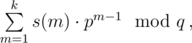
where $*p* = 10^{7} + 19$ and $*q* = 10^{9} + 7$.
Print the answers to events of type 3 in the order in which they appear in the input.
Note
In the first sample, the numbers of displayed exhibits and values $*s*(1), ..., *s*(10)$ for individual events of type 3 are, in order:




The values of individual exhibits are $*v*_{1} = 30, *v*_{2} = 60, *v*_{3} = 5, *v*_{4} = 42, *v*_{5} = 20, *v*_{6} = 40$ and their masses are $*w*_{1} = 4, *w*_{2} = 6, *w*_{3} = 1, *w*_{4} = 5, *w*_{5} = 3, *w*_{6} = 6$.
In the second sample, the only question is asked after removing all exhibits, so $*s*(*m*) = 0$ for any $*m*$.
样例
3 10
30 4
60 6
5 1
9
3
1 42 5
1 20 3
3
2 2
2 4
3
1 40 6
3
556674384
168191145
947033915
181541912
3 1000
100 42
100 47
400 15
4
2 2
2 1
2 3
3
0
题面与样例版权归 Codeforces 及出题人所有;中文翻译由 AI 生成(CI 管线),如有出入请以原文为准。