A function  is called Lipschitz continuous if there is a real constant
$*K*$ such that the inequality $|*f*(*x*) - *f*(*y*)| ≤ *K*·|*x* - *y*|$ holds for all  . We'll deal with a more... discrete version of this term.
For an array  , we define it's Lipschitz constant
 as follows:
- if
$*n* < 2$,
- if
$*n* ≥ 2$,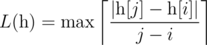 over all
$1 ≤ *i* < *j* ≤ *n*$
In other words,  is the smallest non-negative integer such that
$|*h*[*i*] - *h*[*j*]| ≤ *L*·|*i* - *j*|$ holds for all $1 ≤ *i*, *j* ≤ *n*$.
You are given an array  of size
$*n*$ and $*q*$ queries of the form $[*l*, *r*]$. For each query, consider the subarray  ; determine the sum of Lipschitz constants of all subarrays of
 .
Input
The first line of the input contains two space-separated integers $*n*$ and $*q*$ ($2 ≤ *n* ≤ 100 000$ and $1 ≤ *q* ≤ 100$) — the number of elements in array and the number of queries respectively.
The second line contains $*n*$ space-separated integers  (
 ).
The following $*q*$ lines describe queries. The $*i*$-th of those lines contains two space-separated integers $*l*_{*i*}$ and $*r*_{*i*}$ ($1 ≤ *l*_{*i*} < *r*_{*i*} ≤ *n*$).
Output
Print the answers to all queries in the order in which they are given in the input. For the $*i*$-th query, print one line containing a single integer — the sum of Lipschitz constants of all subarrays of  .
Note
In the first query of the first sample, the Lipschitz constants of subarrays of  with length at least
$2$ are:



The answer to the query is their sum.
样例
10 4
1 5 2 9 1 3 4 2 1 7
2 4
3 8
7 10
1 9
17
82
23
210
7 6
5 7 7 4 6 6 2
1 2
2 3
2 6
1 7
4 7
3 5
2
0
22
59
16
8
题面与样例版权归 Codeforces 及出题人所有;中文翻译由 AI 生成(CI 管线),如有出入请以原文为准。