Mike and !Mike are old childhood rivals, they are opposite in everything they do, except programming. Today they have a problem they cannot solve on their own, but together (with you) — who knows?
Every one of them has an integer sequences $*a*$ and $*b*$ of length $*n*$. Being given a query of the form of pair of integers $(*l*, *r*)$, Mike can instantly tell the value of  while !Mike can instantly tell the value of
 .
Now suppose a robot (you!) asks them all possible different queries of pairs of integers $(*l*, *r*)$ $(1 ≤ *l* ≤ *r* ≤ *n*)$ (so he will make exactly $*n*(*n* + 1) / 2$ queries) and counts how many times their answers coincide, thus for how many pairs 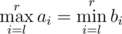 is satisfied.
How many occasions will the robot count?
Input
The first line contains only integer $*n*$ ($1 ≤ *n* ≤ 200 000$).
The second line contains $*n*$ integer numbers $*a*_{1}, *a*_{2}, ..., *a*_{*n*}$ ($- 10^{9} ≤ *a*_{*i*} ≤ 10^{9}$) — the sequence $*a*$.
The third line contains $*n*$ integer numbers $*b*_{1}, *b*_{2}, ..., *b*_{*n*}$ ($- 10^{9} ≤ *b*_{*i*} ≤ 10^{9}$) — the sequence $*b*$.
Output
Print the only integer number — the number of occasions the robot will count, thus for how many pairs is satisfied.
Note
The occasions in the first sample case are:
1.$*l* = 4$,$*r* = 4$ since $*max*{2} = *min*{2}$.
2.$*l* = 4$,$*r* = 5$ since $*max*{2, 1} = *min*{2, 3}$.
There are no occasions in the second sample case since Mike will answer $3$ to any query pair, but !Mike will always answer $1$.
样例
6
1 2 3 2 1 4
6 7 1 2 3 2
2
3
3 3 3
1 1 1
0
题面与样例版权归 Codeforces 及出题人所有;中文翻译由 AI 生成(CI 管线),如有出入请以原文为准。