Touko's favorite sequence of numbers is a permutation $a_1, a_2, \dots, a_n$ of $1, 2, \dots, n$, and she wants some collection of permutations that are similar to her favorite permutation.
She has a collection of $q$ intervals of the form $[l_i, r_i]$ with $1 \le l_i \le r_i \le n$. To create permutations that are similar to her favorite permutation, she coined the following definition:
- A permutation
$b_1, b_2, \dots, b_n$allows an interval$[l', r']$to holds its shape if for any pair of integers$(x, y)$such that$l' \le x \lt y \le r'$, we have$b_x \lt b_y$if and only if$a_x \lt a_y$. - A permutation
$b_1, b_2, \dots, b_n$is$k$-similar if$b$allows all intervals$[l_i, r_i]$for all$1 \le i \le k$to hold their shapes.
Yuu wants to figure out all $k$-similar permutations for Touko, but it turns out this is a very hard task; instead, Yuu will encode the set of all $k$-similar permutations with directed acylic graphs (DAG). Yuu also coined the following definitions for herself:
- A permutation
$b_1, b_2, \dots, b_n$satisfies a DAG$G'$if for all edge$u \to v$in$G'$, we must have$b_u \lt b_v$. - A
$k$-encoding is a DAG$G_k$on the set of vertices$1, 2, \dots, n$such that a permutation$b_1, b_2, \dots, b_n$satisfies$G_k$if and only if$b$is$k$-similar.
Since Yuu is free today, she wants to figure out the minimum number of edges among all $k$-encodings for each $k$ from $1$ to $q$.
Input
The first line contains two integers $n$ and $q$ ($1 \le n \le 25\,000$, $1 \le q \le 100\,000$).
The second line contains $n$ integers $a_1, a_2, \dots, a_n$ which form a permutation of $1, 2, \dots, n$.
The $i$-th of the following $q$ lines contains two integers $l_i$ and $r_i$. ($1 \le l_i \le r_i \le n$).
Output
Print $q$ lines. The $k$-th of them should contain a single integer — The minimum number of edges among all $k$-encodings.
Note
For the first test case:
- All
$1$-similar permutations must allow the interval$[1, 3]$to hold its shape. Therefore, the set of all$1$-similar permutations is$\{[3, 4, 2, 1], [3, 4, 1, 2], [2, 4, 1, 3], [2, 3, 1, 4]\}$. The optimal encoding of these permutations is
- All
$2$-similar permutations must allow the intervals$[1, 3]$and$[2, 4]$to hold their shapes. Therefore, the set of all$2$-similar permutations is$\{[3, 4, 1, 2], [2, 4, 1, 3]\}$. The optimal encoding of these permutations is
- All
$3$-similar permutations must allow the intervals$[1, 3]$,$[2, 4]$, and$[1, 4]$to hold their shapes. Therefore, the set of all$3$-similar permutations only includes$[2, 4, 1, 3]$. The optimal encoding of this permutation is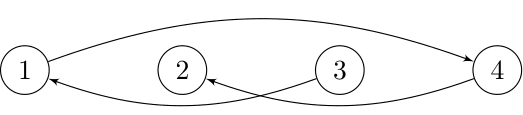
样例
4 3
2 4 1 3
1 3
2 4
1 4
2
4
3
8 4
3 7 4 8 1 5 2 6
3 6
1 6
3 8
1 8
3
5
9
7
10 10
10 5 1 2 7 3 9 4 6 8
2 2
4 5
6 8
4 10
4 4
2 7
2 2
7 8
3 7
2 10
0
1
3
6
6
9
9
9
9
8
题面与样例版权归 Codeforces 及出题人所有;中文翻译由 AI 生成(CI 管线),如有出入请以原文为准。